
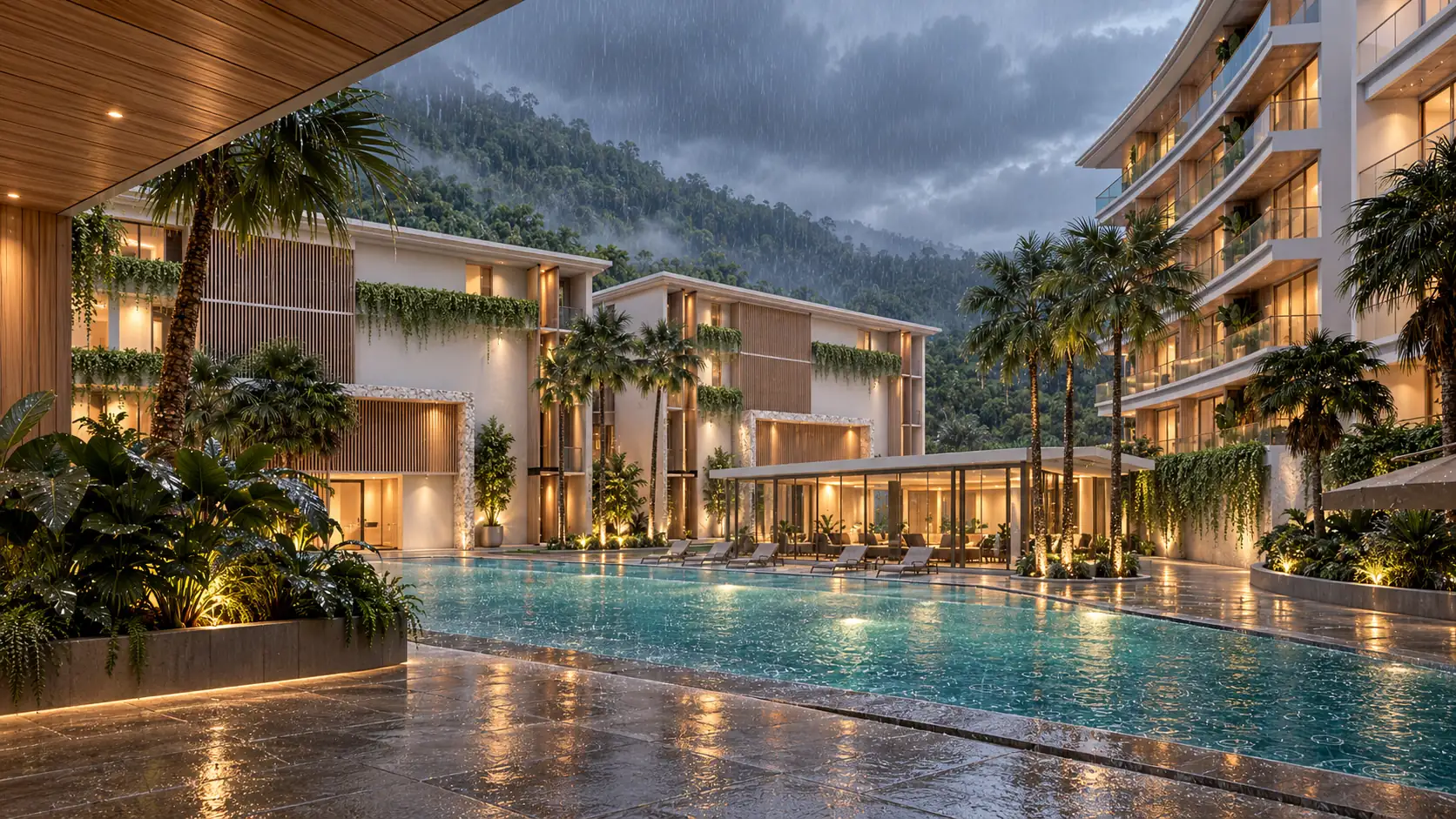
Bang Tao weather follows Phuket’s two monsoons: a drier stretch from about December to March, and a wet southwest monsoon from about mid-May to mid-October. Temperatures barely move through the year, so the month you pick mainly decides how much rain you get and how rough the sea is.
Below are the Thai Meteorological Department’s (TMD) 30-year averages month by month, what the monsoons do to the sea, and which months suit a beach holiday, golf or a property viewing trip. The figures are long-term averages, so check the TMD forecast before you travel.
Bang Tao Weather in Brief
The TMD divides Thailand’s year into a summer from mid-February to mid-May, a rainy season from mid-May to mid-October and a cool season from mid-October to mid-February, and it places Phuket in the southern west-coast region.
The TMD has no station in Bang Tao itself. The averages below come from its Phuket and Phuket Airport stations, so read them as the island’s pattern.
February is the driest month and September the wettest. The Land Development Department also names September as the peak of rainfall on the southern west coast.
October has the most rainy days, and December to March are the four months with the fewest.
Rainfall and Rainy Days by Month
The table shows the TMD’s 1991–2020 averages for the Phuket station (48564).
| Month | Mean rainfall (mm) | Mean rainy days | Mean thunderstorm days |
|---|---|---|---|
| January | 49.9 | 5.6 | 1.4 |
| February | 24.0 | 3.4 | 0.9 |
| March | 80.7 | 7.5 | 3.9 |
| April | 135.1 | 11.7 | 7.5 |
| May | 236.9 | 18.9 | 6.3 |
| June | 249.4 | 18.6 | 3.5 |
| July | 240.2 | 19.1 | 3.6 |
| August | 308.7 | 19.5 | 2.6 |
| September | 350.4 | 21.7 | 2.5 |
| October | 336.0 | 22.7 | 4.8 |
| November | 178.2 | 15.9 | 4.8 |
| December | 82.0 | 10.3 | 1.8 |
| Year | 2,271.5 | 174.9 | 43.6 |
Source: Thai Meteorological Department, Climatological Data of Thailand for 30 Year Period (1991–2020), Phuket station. Read on 29 October 2026.
A “rainy day” in these tables is a day with at least 0.1 mm of rain, so a short shower counts as much as a day of downpours. TAT describes monsoon rain as typically falling for 1-2 hours in the afternoon or early evening, though sometimes for longer. So a day counted as rainy often still has dry hours.
April has more thunderstorm days than any other month, before the main rains begin.

Temperature Through the Year
For temperature, the TMD’s figures for the Phuket Airport station (48565) show little change across the year.
| Month | Mean maximum (°C) | Mean minimum (°C) |
|---|---|---|
| January | 32.1 | 22.9 |
| February | 33.2 | 23.1 |
| March | 33.6 | 23.7 |
| April | 33.5 | 24.2 |
| May | 32.4 | 24.6 |
| June | 31.8 | 24.6 |
| July | 31.5 | 24.6 |
| August | 31.3 | 24.7 |
| September | 30.9 | 24.1 |
| October | 31.0 | 23.7 |
| November | 31.4 | 23.5 |
| December | 31.3 | 23.1 |
March and April have the highest average maximums, and nights are slightly cooler from December to February. The airport station also records more rain than the Phuket station in every month, so rainfall varies even across a small island.
The Two Monsoons and the Wind
The southwest monsoon covers Thailand from about mid-May to mid-October and brings cloud and heavy rain, especially on coasts and windward mountains. The northeast monsoon follows from about mid-October to mid-February. The start and end of both vary from year to year.
At the Phuket station, the prevailing wind blows from the west every month from May to October and swings to the northeast from November to January. Bang Tao Bay faces the Andaman Sea, so in the southwest monsoon the wind comes in from the open sea.
TAT notes that most of Phuket’s west-coast beaches are surfed during the monsoon season and are flat, almost like a lake, outside the swell season.
Sea Conditions and Beach Flags
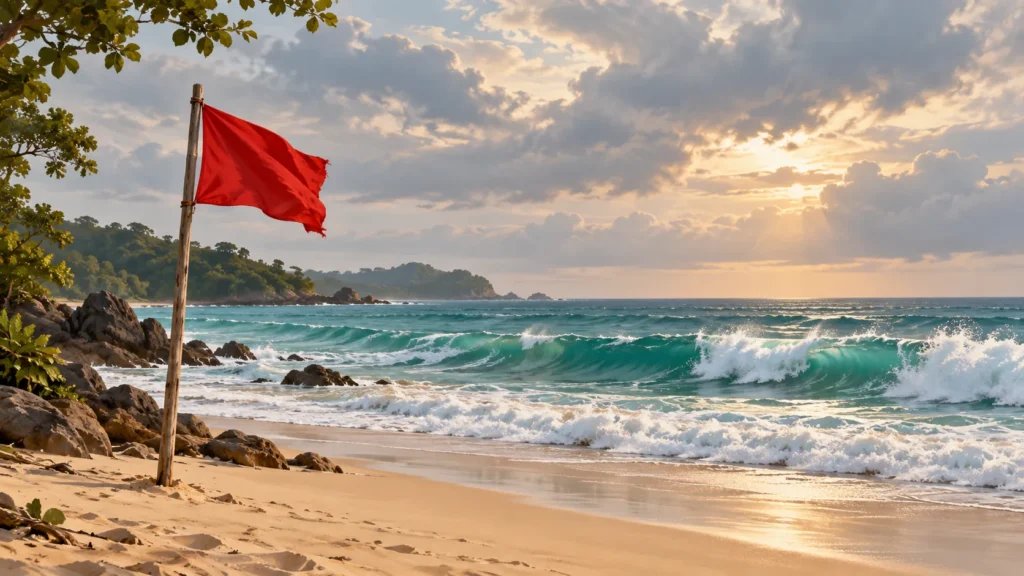
For a beach holiday the sea matters more than the rain. TAT warns that rip currents make swimming dangerous in places like Phuket during the southwest monsoon, and explains the beach flags:
- Red: do not swim.
- Yellow: swimming allowed, with caution.
- Green: calm water.
- Red and yellow together: lifeguards on duty.
During the monsoon, Phuket’s local authorities put up red flags in Thai, English, Chinese and Russian and urge visitors to stay out of the water when they fly. Even water that looks shallow can hold powerful waves.
TAT lists a manned lifeguard tower at Surin Beach, just south of Bang Tao; check that it is staffed on the day. In an emergency in Thailand, call 1669 for emergency medical services or 191 for general emergencies, and the Tourist Police are on 1155.
Which Months Suit What
The suggestions in this table are ours, based on the TMD figures.
| Months | Typical pattern | Good for |
|---|---|---|
| December to March | The four months with the fewest rainy days | Beach days and swimming on green-flag days, outdoor markets, golf |
| April | The most thunderstorm days, and with March the highest average maximums | Early-morning activities; plan indoor afternoons |
| May to October | Southwest monsoon, wettest from August to October | Spa, classes and indoor plans, short beach walks; surf on suitable beaches; seeing how a property handles rain |
| November | Rain easing, northeast monsoon beginning | A transition month; check the forecast and flags |
For golf, book early tee times in the wetter months, since rain often comes in the afternoon. Our guide to things to do in Bang Tao has ideas for both dry and wet days.
A viewing trip in the rainy season has a practical upside for buyers: you can see how roads, drainage and buildings cope with heavy rain, which you cannot judge in February.
Owners who leave a home closed up through the wet months should plan for humidity. The US Environmental Protection Agency advises keeping indoor humidity below 60 percent where possible and using air conditioning or a dehumidifier when needed, because controlling moisture is how you control mould. Ask whoever manages your home how it is aired and checked while you are away.
If you plan to rent a property out, rental demand also moves with the seasons; our Phuket rental seasonality guide covers that side.
Rainy Days at The Trees Residence
The Trees Residence is in Bangtao, Phuket. For wet afternoons, the brochure lists indoor and sheltered facilities among the planned amenities, including fitness, a sauna and ice bath, massage and spa, a kids club, a co-working space and a library.
Bangtao Beach, Porto de Phuket and Laguna Golf Course are listed at around 10 minutes by car, so it is easy to get out to the beach or the course when the weather clears. See the project overview for the full facilities list, or read our Bang Tao area guide.
Frequently Asked Questions
When is the driest time to visit Bang Tao?
February has the lowest average rainfall and the fewest rainy days at the TMD’s Phuket station. December to March as a whole are the drier months.
When is the rainy season in Bang Tao?
The southwest monsoon runs from about mid-May to mid-October, and the start and end vary each year. September and October are usually the wettest months.
Is it safe to swim at Bang Tao in the monsoon?
Only when the flags allow it. Red means do not swim, and TAT warns of rip currents in Phuket during the southwest monsoon. Follow the flags and any lifeguard instructions.
How hot is Bang Tao?
At the Phuket Airport station, average daily maximums run from 30.9°C in September to 33.6°C in March, with average minimums between 22.9°C and 24.7°C.
Does it rain all day in the rainy season?
Usually not. TAT says monsoon rain typically falls for 1-2 hours in the afternoon or early evening, though it can last longer.
Final Takeaway
Bang Tao weather is warm all year. What changes from month to month is the rain and the sea.
December to March gives the calmest beach days. In the monsoon months, keep afternoons for indoor plans and read the beach flags before every swim.
If Bang Tao is on your shortlist for a home, explore The Trees Residence and ask our team for the latest project information before arranging a private viewing.
Information note: Climate figures in this article are 30-year averages (1991–2020) published by the Thai Meteorological Department and are not a forecast. Monsoon timing varies from year to year. Beach safety guidance comes from the Tourism Authority of Thailand and local authority warnings. Always follow beach flags and lifeguard instructions, and check the current forecast before you travel. Facilities at The Trees Residence are based on the developer’s brochure and are subject to change.
Image note: Images in this article are AI-assisted illustrations, including visuals based on The Trees Residence architectural renderings. They are not photographs of the completed project.
Find Your Private Sanctuary in Bangtao
Speak with our team to explore ownership opportunities at The Trees Residence by Anocha.