

Phuket rental yield is a ratio, and a ratio is only as honest as the numbers on either side of it. Two brochures can quote the same figure and mean different things, because one counts revenue before costs and the other counts what reaches the owner.
This guide gives you the formulas in plain letters, the cost lines between gross and net, and a worksheet any seller can complete in writing. It contains no sample percentages, because the aim is to check other people’s figures, not supply one.
For the wider checklist on rental potential, read our Phuket long-term rental potential guide. This guide goes deeper on one step of it: the arithmetic behind a quoted figure.
What Gross and Net Figures Measure
Rental yield compares a year of rent revenue with the value of the property, as NAB’s consumer guide explains. The phrase “Phuket rental yield” therefore means nothing until you know which revenue and which value were used. Gross yield uses revenue before expenses. Net yield subtracts the annual expenses first.
That is all it does. It does not show whether the property will rise in value, whether guests or tenants will keep coming, or what the costs will be next year. A high yield may also come at the cost of slower growth in value. Use it as one input, next to the exit and growth questions in our guide to income, growth and exit.
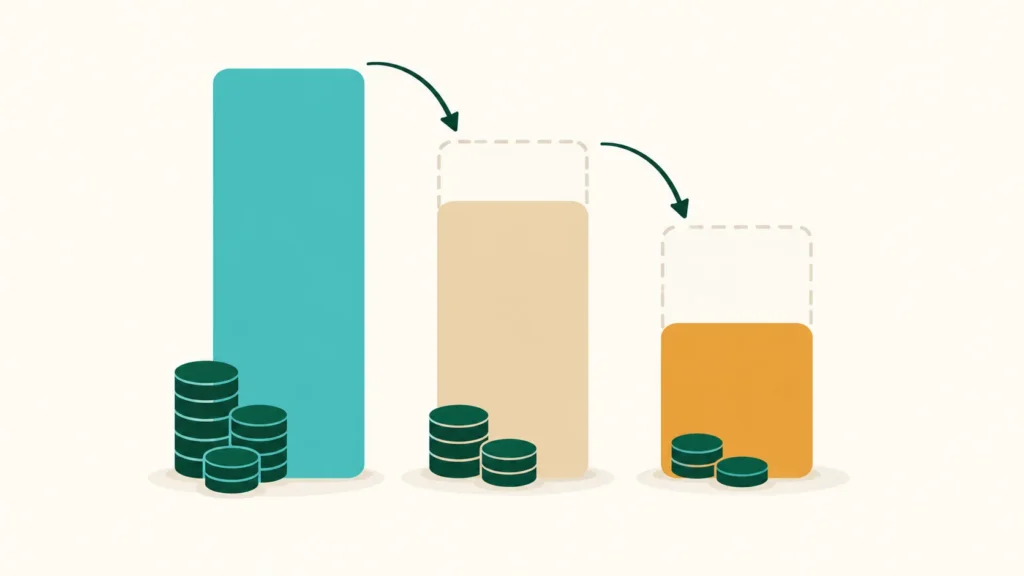
The Formula in Four Letters
Ask every seller to define each letter in writing.
- A = the annual rent or room revenue the figure is based on.
- B = deductions taken before the owner is paid, such as operator costs.
- C = costs the owner pays separately, after the payout.
- D = the value the figure is divided by.
Then three different figures exist:
- Gross figure = A ÷ D
- After-deductions figure = (A − B) ÷ D
- True net figure = (A − B − C) ÷ D
Multiply any of them by 100 to show a percentage.
The middle line matters. An offer can call the after-deductions figure “net”, but it ignores the costs in C. Always ask which of the three a quote shows.
Check D as well. It can be the price you paid, today’s market value or a price list figure, and these can differ. Ask whether D includes furniture packages and buying costs.
Costs Between Gross and Net
The table lists cost lines to check. It does not give typical rates, because rates differ by project and contract. Ask which letter each line falls under, B or C, or whether it is left out.
| Cost line | What it covers | Question to ask |
|---|---|---|
| Booking and payment fees | Platform commissions, card charges | Deducted before payout or billed separately? |
| Housekeeping and laundry | Cleaning between stays, linen | Fixed or per stay? Who sets the price? |
| Utilities | Water, power, internet in the unit | Billed to the owner or included? |
| Sales and marketing | Commissions, advertising | Fixed or a share of revenue? |
| Management fee | The operator’s charge | Fixed or a share? How can it change? |
| Common-area charges and reserve | Building upkeep, sinking fund | Who sets them? By unit or by size? |
| Repairs and furniture replacement | Wear and tear on the unit | Who pays and who decides? |
| Taxes | Tax on rent revenue | Who files and who withholds? |
| Insurance | Building and contents | Included in common charges? |
| Owner-use nights | Nights you stay yourself | Are they charged? How many are allowed? |
Owner-use nights lower A, because those nights earn no revenue. Include them in the calculation if you plan to stay.
Tax treatment depends on your residency and on how income is paid. Our guide to tax on rent for foreign owners covers it, and an accountant should confirm your own position.
Occupancy, ADR and RevPAR
A hotel-style programme builds A from three connected measures.
- Occupancy = nights sold ÷ nights available.
- ADR (average daily rate) = room revenue ÷ nights sold.
- RevPAR (revenue per available room) = room revenue ÷ nights available, which equals occupancy × ADR.
Two projects can reach the same A in different ways. One may sell many nights at a low rate. Another may sell fewer nights at a higher rate. Ask for all three measures, not just the total.
Ask also whether the figures are projected or achieved. A projection is an assumption. Achieved statements for a comparable unit over a full twelve months are evidence. Because demand changes through the year, read our guide to rental seasonality and owner cash flow before you annualise any single month.
Fixed Payments Versus Revenue Share
Offers fall into a few shapes. Ask which one you are looking at.
- A fixed payment for a set period. The owner receives an agreed amount whatever the bookings.
- Revenue share. The owner receives a share of A, usually before some costs.
- Profit share. The owner receives a share of what remains after costs.
- Rental pool. Revenue from many units is combined and divided among owners.
The U.S. Securities and Exchange Commission’s investor-education site says every investment carries some degree of risk, and advises being highly suspicious of any “guaranteed” investment opportunity. That is guidance for investments in general, not a statement about any Thai project. It is still a good reason to read what stands behind a promised payment.
For a fixed payment, ask:
- Which legal entity pays, and is that the developer or the operator?
- What backs the payment if bookings fall short?
- How long does it last, and what happens afterwards?
- Does the purchase price reflect the promised payment?
- What can you do if a payment is missed?
For a revenue share, ask which costs are taken before your share and who audits the figures. Our management agreement checklist covers reporting and audit rights.

Red Flags in a Quoted Figure
Pause when you see any of these:
- A figure with no stated base.
- A “net” figure with no list of deductions.
- A projection presented as a result.
- A figure built from one peak month, multiplied up to a year.
- A “guaranteed” figure with no named payer.
- A figure for a different unit type from the one you would buy.
- A figure that ignores owner-use nights.
- Reluctance to share sample owner statements.
None of these proves a problem. Each is a reason to ask for the working behind the number.
Laguna vs Non-Laguna: Comparing Fairly
Buyers often compare a project in the Laguna area with one outside it. A comparison works only when both figures are built the same way.
- Same letters. A, B, C and D are defined identically in both.
- Same period. Both cover the same twelve months.
- Same unit type. Compare a one-bedroom with a one-bedroom.
- Same use rules. Owner-use nights are treated the same way.
- Same status. Compare achieved with achieved and projected with projected.
- Same source. Ask for statements, not summaries.
If you cannot get the same inputs, do not compare the figures. Compare the documents instead. Our Bang Tao vs Laguna guide explains how the two areas differ in character, and our 10-point scorecard helps you rank projects on the points a ratio cannot show.
A Worksheet to Complete in Writing
Ask the seller or operator to fill in each line before you rely on any figure:
- Period covered, with start and end dates.
- Unit type and whether it is furnished.
- A: revenue, and whether it is before or after the operator’s charges.
- B: every deduction taken before payout.
- C: every cost you pay separately.
- D: the value used, and what it includes.
- Occupancy, ADR and owner-use nights.
- Projected or achieved.
- Who prepared it and on what date.
Keep the completed sheet with your contract documents.
Applying This to The Trees Residence
The Trees Residence describes itself as a hotel-managed premium residence in Bangtao, fully managed by a professional hotel operator. Under that model, the line between A and B matters, because operator charges may sit between room revenue and the owner’s payment.
Use the worksheet above. Ask our team for the written method that turns room revenue into the owner’s payment, a sample owner statement and the full fee schedule. Then compare the answers with any other project on the same terms. The project overview has the current details.
Frequently Asked Questions
What is the difference between gross and net rental yield in Phuket?
Gross yield compares annual rent revenue with the property’s value before expenses. Net yield subtracts annual expenses first. Ask any seller which one a quote shows, and which costs it includes.
Is the figure in a brochure what I will receive?
Not necessarily. A rental yield in a brochure is often a gross or projected number. What you receive depends on the deductions, the owner-use nights, and actual bookings. Ask for the working behind it.
What is a good rental yield in Phuket?
This guide does not give a benchmark, because a number without a method is not useful. Judge an offer by how clearly it defines A, B, C and D, and by whether it comes with achieved statements.
How do I compare a Laguna project with one outside Laguna?
Use the same letters, period, unit type, use rules and source for both, as in the section above. If you cannot, compare the contracts and cost schedules instead of the headline figures.
Is a promised fixed return safer than a revenue share?
Not automatically. A promised payment is only as reliable as the party that pays it and the terms behind it. Ask who pays, what backs the payment and what happens when it ends.
Final Takeaway
A rental yield figure is useful only when you know what is above and below the line.
Define A, B, C and D. Ask which of the three figures a quote shows. Compare projects only on equal terms and keep the signed-off worksheet with your documents.
If you are comparing hotel-managed options in Bang Tao, explore The Trees Residence and request the income-calculation method and fee schedule before arranging a private viewing.

Information note: This article is general information only. It is not legal, tax or financial advice and it does not forecast the performance of any property. The definitions of gross and net figures come from Australian bank consumer guides and are used here only for the general concept. The investor guidance cited is from the U.S. SEC. All sources were read on 20 October 2026. Laws, fees and project terms can change, so confirm current details with your own lawyer, accountant and the project’s written documents before you buy.
Image note: Images in this article are AI-assisted illustrations, including visuals based on The Trees Residence architectural renderings. They are not photographs of the completed project.
Find Your Private Sanctuary in Bangtao
Speak with our team to explore ownership opportunities at The Trees Residence by Anocha.